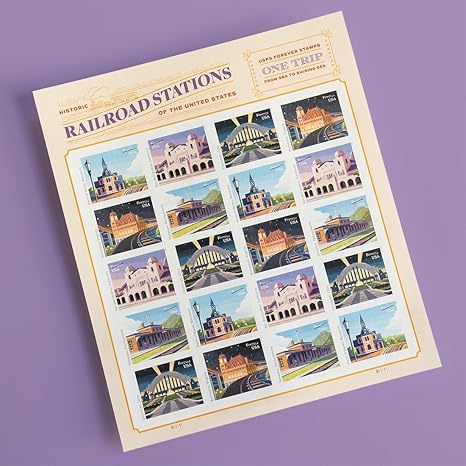
The “Historic Railroad Stations” stamps issued by the U.S. Postal Service celebrate the history of train travel and the significant role railroad stations played in American development.
Answer: The history represented by these stamps highlights the evolution and importance of railroad stations in the United States, from their emergence as centers of commerce and travel to their eventual decline and subsequent preservation efforts.
Explanation:
Rise of Railroad Stations: In the 1800s, particularly from the 1870s onwards, noteworthy railroad stations became prominent landmarks across the American landscape, serving as vital hubs for commerce, travel, and even mail transportation.
Economic and Social Impact: Railroads and their stations were instrumental in fueling economic expansion and industrialization, connecting various regions, and facilitating the movement of goods, people, and ideas, thus contributing to a sense of national identity.
Decline and Preservation: By the 1960s and early 1970s, a sharp decline in rail traffic left many of these grand structures endangered, with some facing demolition. However, dedicated efforts by preservationists and local communities led to the preservation, reactivation, and reuse of many historic stations, which now often house museums, government offices, or continue to serve as transportation hubs.
Featured Stations: The stamp series itself features five specific architectural gems: Cincinnati Union Terminal, Main Street Station in Richmond, Virginia, Point of Rocks Station in Maryland, San Bernardino Depot in California, and South Station in Boston. Each of these stations has its own unique history of construction, service, and, in many cases, preservation and revitalization.
























Berkeley –
I love these railroad ones. Exactly as described.